Confined routing
Flat and Robot Cable
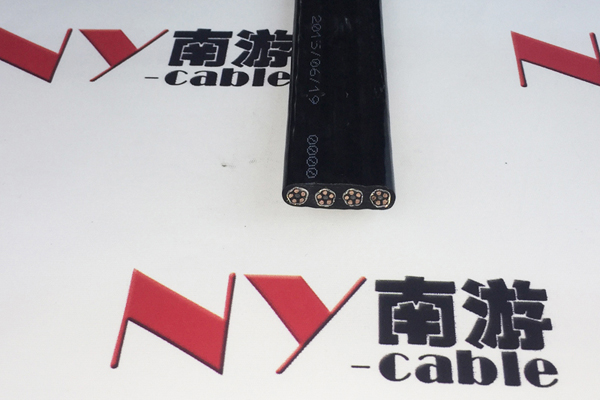
Flat profile for the places a round cable will not go: confined routing, tight radii and compression under a moving axis.
FlatProfile
CustomCores
1 kVMax rated
100 mMOQ
Flat profile for the places a round cable will not go: confined routing, tight radii and compression under a moving axis.
A flat cable solves two geometric problems at once: it bends in one plane only, so it can be routed where a round cable's bend radius will not fit, and it resists being squashed where a round cable would roll or flatten under a moving part. The trade-off is that a flat cable must be oriented correctly — bending it out of plane is the failure mode. Core count is specified per order because the profile is built around the cores, not selected from a list.
| Parameter | Value |
|---|---|
| Rated voltage | up to 1 kV |
| Conductor | tinned copper |
| Profile | flat |
| Jacket options | nitrile (NBR) / polyurethane (PUR) |
| Core count | to customer specification |
| Operating temperature, PUR | -40 to +80 °C |
| Operating temperature, NBR | -15 to +70 °C |
| Minimum order | 100 m |
Confined spaces, one-plane bending and compression.
Flat and robot cable buying questions.
Two reasons: it bends in a single plane, so it fits a tighter envelope than a round cable of the same cross-section, and it resists compression where a round cable would roll or flatten. The constraint is that it must be installed with the bend plane oriented correctly.
Yes. The profile is built around the cores rather than chosen from a fixed list, so core count, cross-section and the mix of power and control cores are specified per order from 100 m.
Flex life follows the jacket compound, as with our round constructions: 3,000,000+ cycles with NBR, 5,000,000+ with PUR. The flat profile does not change the jacket's fatigue behaviour, only the geometry of the bend.
MOQ 100 m · standard lead time 5-7 days · CE and RoHS documentation